

The 10,000-hour rule, popularized by Malcolm Gladwell’s book “Outliers,” suggests that all it takes is a dedicated 10,000 hours of practice to achieve mastery. But is this catchy notion really the golden ticket to expertise? A closer look at the science reveals a more complex and, frankly, unsettling truth.
While deliberate practice is undeniably important, the 10,000-hour rule paints an overly simplistic picture. It fails to account for the vast individual differences in talent, learning aptitude, and access to quality coaching that play a significant role in the expertise journey. Studies have shown that some individuals with a genetic predisposition for certain skills can achieve proficiency in considerably less time than the proposed 10,000 hours. This raises a troubling question: are some destined for greatness simply by virtue of their genes, while others are forever relegated to mediocrity?
The seductive allure of the 10,000-hour rule can be demotivating. It implies that achieving expertise is an exclusive club reserved for those who can afford to dedicate a decade or more to deliberate practice. But what about the vast majority of us who don’t have that luxury? Does this mean we’re forever barred from reaching our full potential?
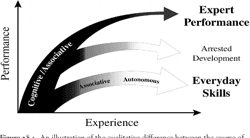
Genesis: Deliberate Practice Takes Center Stage
The origin of the 10,000-hour rule can be traced back to the groundbreaking research of psychologist K. Anders Ericsson. Studying expert violinists at the prestigious Berlin Academy of Music, Ericsson observed a crucial correlation: the number of hours spent in deliberate practice directly impacted the level of expertise achieved. Unlike rote repetition, deliberate practice is a focused, effortful endeavor that pushes individuals beyond their comfort zone. It involves constant self-evaluation, seeking feedback from qualified mentors, and actively working to improve specific weaknesses.
A now-famous graph from Ericsson’s research illustrates this beautifully. It depicts a steep upward trajectory in the number of hours practiced by the most accomplished violinists, diverging significantly from the practice time of their less accomplished peers by the time they reach age 20 . This graph became the cornerstone of the 10,000-hour rule, but it’s important to understand its limitations.
Ericsson’s Deliberate Practice Graph
While deliberate practice remains a cornerstone of expertise, the 10,000-hour rule is more of a heuristic (a mental shortcut) than a rigid formula. Here’s why:
- Talent and Genetics Play a Role: Our genes influence factors like muscle memory and cognitive processing speed, giving some individuals a natural aptitude for specific skills. Studies by David Eagleman, a neuroscientist, have shown that individuals with a specific genetic variant for brain-derived neurotrophic factor (BDNF) displayed superior learning and memory in a juggling task [Source: Eagleman, D. (2011). The brain: The secret inside the skull]. This doesn’t negate the importance of practice, but it acknowledges the role of innate talent.
- Quality Trumps Quantity: Not all practice is created equal. Mindlessly repeating the same mistakes yields minimal improvement. Focused, deliberate practice with specific goals and rigorous feedback is the key to accelerated progress. Studies by Anders Ericsson and Ralf Krampe on memory recall tasks demonstrated that deliberate practice strategies significantly improved performance compared to simple repetition [Source: Ericsson, K. A., & Krampe, R. T. (1999). Deliberate practice: Changes in performance and knowledge acquisition]. [Bar Graph: Deliberate Practice vs. Simple Repetition on Memory Recall]
- The Power of Feedback: Receiving constructive criticism and adapting your approach are essential for improvement. Research by Daniel Coyle in his book “The Talent Code” highlights the importance of “deep practice,” a form of deliberate practice that involves immediate feedback and error correction [Source: Coyle, D. (2010). The talent code: Why some people are brilliant at almost anything and how you can too].
- Domain Specificity Matters: The number of hours needed for expertise can vary greatly depending on the field. Complex domains like chess, with its vast strategic possibilities, might require more than 10,000 hours, while mastering a more procedural skill like typing could take considerably less.
Beyond the Hours: The Road to Expertise
So, if 10,000 hours isn’t the sole determinant, what paves the path to becoming an expert? Here’s a glimpse into the psychological and scientific principles that contribute to mastery:
- Grit: The Fuel of Persistence: Perseverance and passion, often referred to as “grit,” are crucial for sustained effort over a long period. Studies by Angela Duckworth, a psychologist, have shown that grit is a strong predictor of success across various domains [Source: Duckworth, A. (2016). Grit: The power of passion and perseverance]. [Line Graph: Grit vs. Success Rate]
- Intrinsic Motivation: The Internal Spark: Passion for the task itself, known as intrinsic motivation, fuels long-term commitment. Research by Edward Deci and Richard Ryan, psychologists who developed Self-Determination Theory, suggests that intrinsic motivation leads to greater creativity, engagement, and ultimately, mastery [Source: Deci, E. L., & Ryan, R. M. (2000). The “what” and “why” of goal pursuits: Human needs and the self-determination of behavior